The chemistry of halogens is part of the cycle in the fabrication of multiple chemicals. That alone explains the importance of having a closed halogen loop so this process occurs in an efficient and sustainable manner. That “recycling” idea is what Prof. Javier Pérez-Ramirez (aCe Catalisys Engineering at ETH Hönggerberg) wanted to picture in this image, which made it to the cover of Chemical Reviews.

Category Archives: Picture
On charging your phone with your jumper
Imagine having your your battery charger printed on your clothes or on the screen of your cellphone… this is what Organic Nanostructured Photovoltaics group, at ICFO is proposing. The use of organic electronics allows the production of flexible cells which happen to be highly inefficient. By layering nanoparticles in a clever way, they’ve been able to increase the performance of these devices, thus solving the problem.
With the help of Dr. Silvia Colodrero, we created this picture which made it to the cover of Advanced Functional Materials.
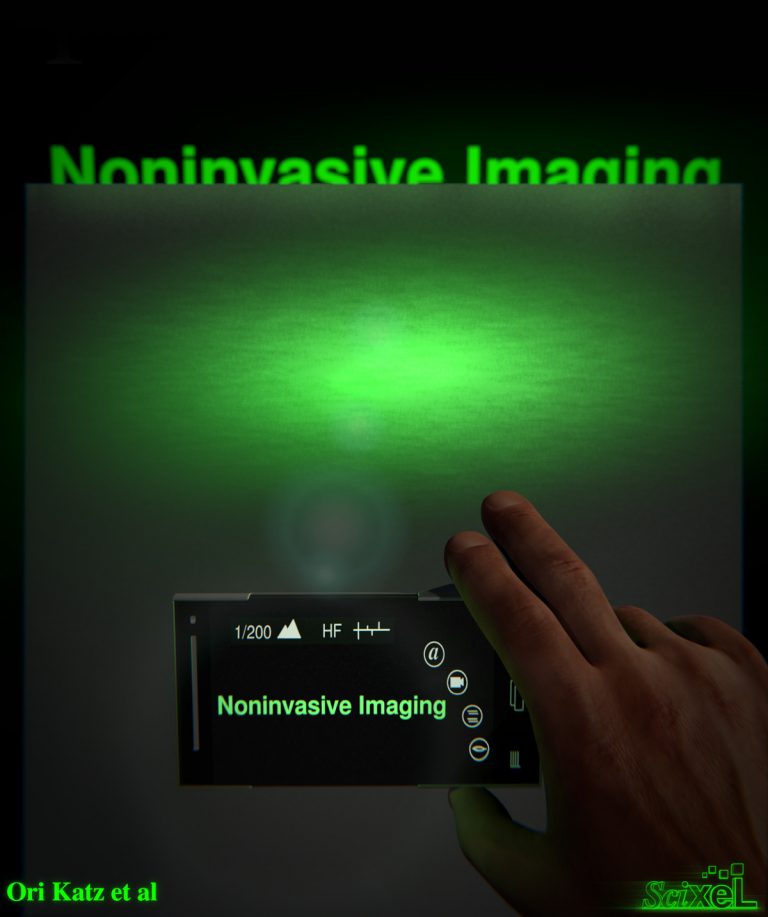
Widefield Lensless Endoscopy via Speckle Correlations
If you want to know about cool stuff going on in the optics field, check out the Advanced Imaging Lab, at the Hebrew University of Jerusalem. Now they’ve come up with a way to make Widefield Lensless Endoscopy via Speckle Correlations. In short, this means smaller devices and better quality images by using speckle correlations in multicore fibers.
To illustrate it, and requested by Dr. Ori Katz we did this image for them. It made it to the inside cover of OPN.
Working with them gets you in a state of something in between astonishment and “… you sure this is really possible???”. Like that time in 2014, when they claimed they were able to recover images through scattering layers and around corners. Well, it happened to be so true, it was published in Nature Photonics.
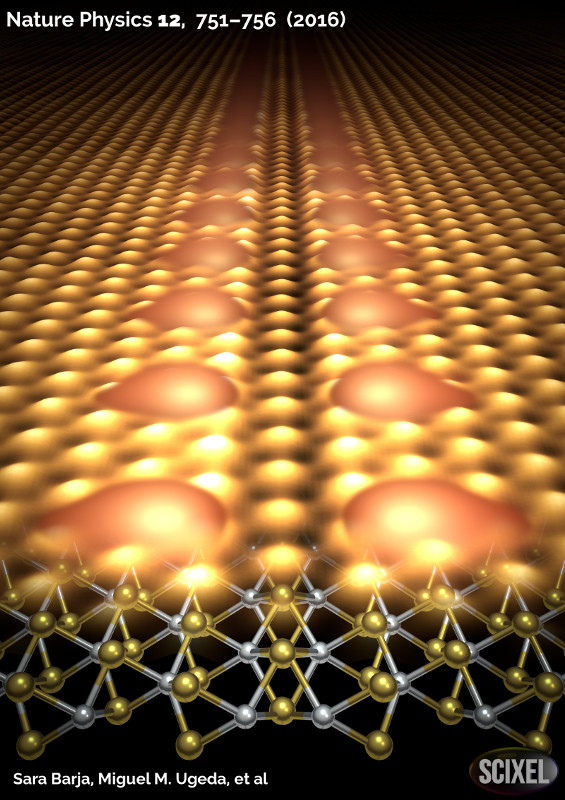
1D charge density waves
Another milestone in the understanding of 2D semiconductors. S. Barja (Berkeley) , M. M. Ugeda (CIC Nanogune) et al. have observed the formation of one-dimensional charge density waves along mirror twin boundaries in MoSe2. This research opens the door to the study of charge transport in this type of materials.
Sadly, the picture didn’t make it to the cover of Nature Physics, but both the research and the picture are beautiful enough to show off a little.
Van der Waals at its best!
Physicists measure van der Waals forces of individual atoms for the first time. Prof. Ernst Meyer et al, have succeeded in measuring the very weak van der Waals forces between individual atoms for the first time. To do this, they fixed individual noble gas atoms within a molecular network and determined the interactions with a single xenon atom that they had positioned at the tip of an atomic force microscope.
Prof. Ernst Meyer asked Scixel for a visual representation of their work, published in Nature Communications.