The CNB (Centro Nacional de Biotecnología, Spain) has made a collection of short videos to explain some of their research: from plants that decontaminate our environment to cancer inmunotherapies. They’ll be publishing them weekly. Here you have some examples:
The films where beautifully directed by Filmociencia. We helped them with the infography.
Prof. Fernández-Rossier is an interesting person for many reasons. Apart from his research work and being a Spinograph partner, he has recently started a new research center (QuantaLab). And some how he still manages to find some time for scientific outreach. And this is a good example.
Here he explains the mass production of the ubiquitous graphene.
We just helped with the video. And as a side note, we are particularly proud of the music piece.
One of those things that make you wonder “is this even possible?” while your jaw is still dropping.
Then Netherlands are funding the consortium BaSyC in order for them to build a synthetic biological cell. It is hard to foresee what new pieces of knowledge and technology this research will produce. But in the short term, by building a cell bottom-up, we will learn to understand the cell at its most fundamental level.
The BaSyC consortium includes the University of Amsterdam, the Radboud University, the University of Wageningen, the Vrije University of Amsterdam, as well as our old friends in TuDelft. Actually they were the one that contacted us to make this animation illustrating the process.
Click here if you want to know more about the project.
Finally we’ve found some time to produce our 2016 demoreel. It’s been a great year. We’ve worked with a lot of new people in Spain and abroad. Lots of amazing projects both artistically and scientifically. These are some of them:
This is a way of both showing off about the people we’ve worked with and expressing some gratitude. It is difficult not to feel lucky.
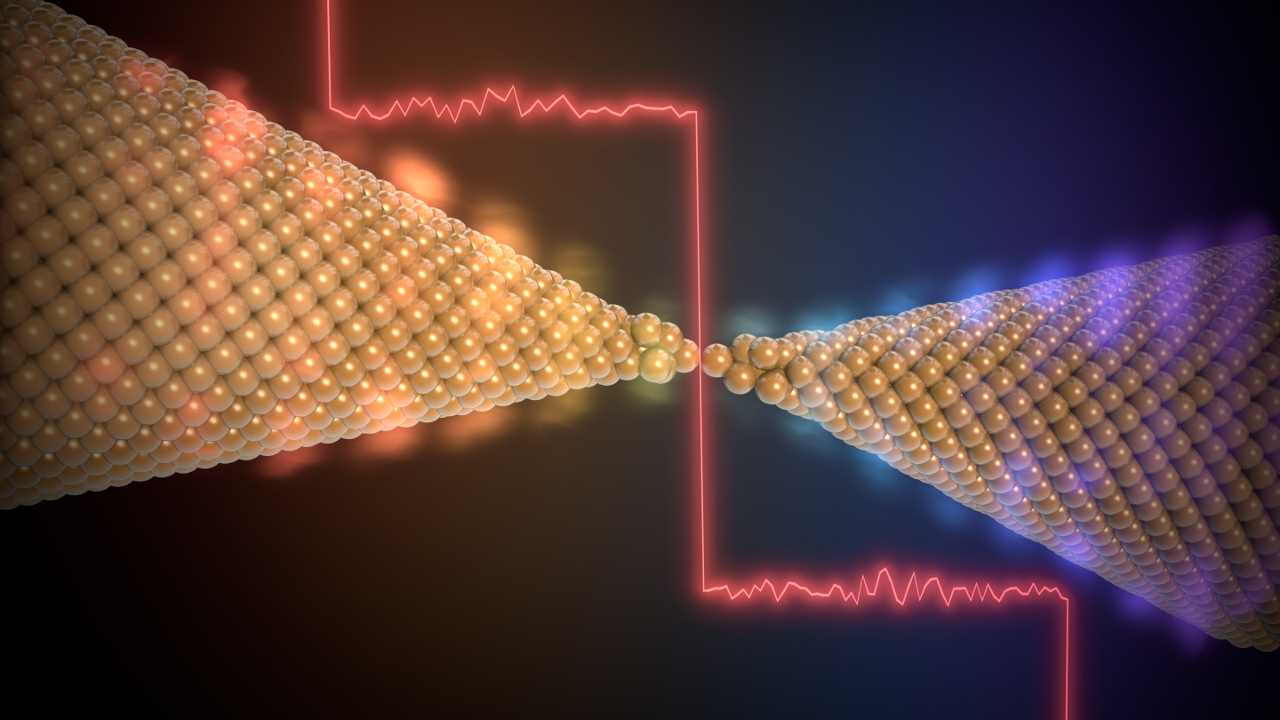
While quantized electrical conductance was pretty well known and proof for quite a while, quantized thermal transport observation was still slipping away from researchers eyes. Until now.
This changes the game. And we had the opportunity to make this explanatory video for them with the help of Prof. J. C. Cuevas (UAM) and Longji Cui (UMICH). One of those times when your job pays off.
Researchers from the Graphene Flagship at TU Delft have found a new potential application for graphene: mechanical pixels. By applying a pressure difference across graphene membranes, the perceived color of the graphene can be shifted continuously from red to blue.
In this simulation, requested by Santiago Cartamil and performed by Scixel, graphene changes its colour depending on its own deformation. These pixels, which do not emit light themselves but are visible in sunlight, could lead to energy-efficient colour displays that can be used in devices such as e-books and smart watches.
Are we witnessing a change of paradigm?
Circles is a powerful short movie based on a poem, based on a piece of music. Just the piece of music survived.
We also wanted to mix two techniques: 3D plus rough pencil traditional animation.
This is a side project of Scixel with two purposes: to sharpen our skills and to save money on therapists sessions.